MVP Project Management Your Guide to Product Strategy
Master MVP project management with this practical guide. Learn to define scope, prioritize features, and use feedback to build products people actually want.

At its core, MVP project management is about one thing: building a product with the bare-minimum features needed to grab the attention of early users and prove your idea has legs. It’s a philosophy that puts learning ahead of perfection, allowing you to get real feedback from actual users—fast.
This whole approach is about launching quickly, learning even faster, and most importantly, avoiding the soul-crushing experience of building something nobody actually wants.
Why MVP Project Management Matters Now More Than Ever
Let's be honest: building a new product is a gamble. You're always up against two big risks. You could spend a fortune building a beautiful product that completely misses the mark with users, or you could burn through all your cash chasing a flawless, feature-packed version that never even launches.
This is exactly where the Minimum Viable Product (MVP) strategy comes in. Think of it as a framework designed to get the most learning out of the least amount of work.
Forget the old-school "big bang" launch, where you'd spend years developing in secret before a grand reveal. The MVP model turns that idea on its head. You build a lean, core version of your product and get it into the hands of a small group of users as soon as possible. This first release isn't meant to be the final version; it's a conversation starter.
This classic diagram really nails the concept. An MVP delivers a functional, reliable, and usable slice of the product right from the start.

It’s a great visual because it clears up a common mistake. An MVP isn't just a wheel or a chassis—an incomplete part of a bigger thing. It's a skateboard. It gets the job done from day one, even if it's not the fancy convertible you'll build later.
The Shift to Agile and Data-Driven Decisions
The move toward MVP isn't happening in a vacuum. It reflects a major shift in how smart companies build things today. The goal isn't just to ship a project; it's to ship the right project—one that genuinely solves a problem for your users.
The numbers back this up.
The adoption of agile methodologies, which go hand-in-hand with the MVP concept, has exploded. Over 71% of US companies now use Agile as their main approach to project management. Teams using frameworks like Scrum, which lean heavily on MVP thinking, are more than twice as successful as those using traditional methods. We’re talking about product quality jumps of up to 250%. You can find more project management statistics at Flowlu.com.
This data-driven success is why MVP project management has become the standard playbook. It gives you a structured way to test your assumptions, collect real data, and adjust your course based on what users actually do, not what you think they'll do.
For anyone looking for a deep dive into getting started, this guide is a fantastic resource: A Founder's Guide to Building an MVP Mobile App. Ultimately, it’s all about making smarter, more sustainable decisions—powered by evidence, not just a gut feeling.
Defining Your Core Problem and Viable Scope
Every great product starts by solving a real, nagging problem—not just with a cool idea. When you're managing an MVP, your first job is to get crystal clear on what that problem is. This isn't just a box-ticking exercise; it sets the entire foundation for a product people will actually want to use.
Before you even think about code, you have to get inside your users' heads. This means talking to them, understanding their frustrations, and validating their biggest pain points. We often see teams skip this, but it’s a critical part of a solid project discovery phase that saves you from building a beautiful solution to a problem nobody has.
Taking this time upfront dramatically cuts your risk. In fact, research shows that a staggering 37% of projects fail simply because their goals were fuzzy from the start. The whole point of an MVP is to fight that statistic by forcing you to define the absolute smallest thing you can build that delivers genuine value. You can read the full research on project management statistics to see just how common this pitfall is.
From Broad Idea to Sharp Problem Statement
Let's get practical. Imagine you want to build a new food delivery app. A goal like "make food delivery better" is way too broad. It gives you no direction. You have to dig deeper.
Start asking specific, targeted questions to find a real pain point:
- For a busy professional, what’s the most annoying part of ordering food online right now?
- Are local restaurant owners getting crushed by the huge commission fees from the big apps?
- Is there a group of eco-conscious customers who would pay more for sustainable packaging?
Let’s say you talk to a dozen local restaurant owners. You quickly discover they're desperate for a low-commission alternative to the big platforms. Boom. You've just found your problem statement: "Independent restaurants need a cost-effective way to offer delivery without giving away their already thin profit margins." Now that's a problem you can build a solution for.
Ruthlessly Prioritizing with the MoSCoW Method
Once you know the problem, the next battle is scope. This is where so many projects go off the rails with "feature creep"—that endless list of nice-to-haves that balloons the budget and timeline. You need a system to say "no."
The MoSCoW method is a beautifully simple framework for this. It helps you and your team ruthlessly prioritize by sorting every potential feature into four clear categories:
- Must-have: These are the absolute deal-breakers. The product simply won't work without them. For our restaurant app, this would be things like a list of restaurants, a simple menu, and a way to place an order.
- Should-have: Important, but not essential for the very first version. Maybe live order tracking or the ability to save favorite restaurants fits here.
- Could-have: These are the "nice-to-have" features that can definitely wait. Think advanced dietary filters or social sharing buttons.
- Won't-have: Anything explicitly out of scope for now. A customer loyalty program or a separate app for drivers would fall into this bucket.
A framework like MoSCoW draws a line in the sand. It forces you to make tough decisions, turning a vague wishlist into a focused, objective plan. This is how you ensure your MVP solves one core problem incredibly well, instead of trying to solve ten problems poorly.
Bringing The Build-Measure-Learn Loop To Life
At the heart of any successful MVP project is a simple yet powerful cycle: Build-Measure-Learn. This isn't just another piece of startup jargon; it's a practical framework that keeps you from building in the dark. It’s how you stop guessing and start learning what your users actually need.
Think of it as a continuous conversation with your market. You build a small piece of the puzzle, measure how people react, and learn from their behavior to decide what to build next.
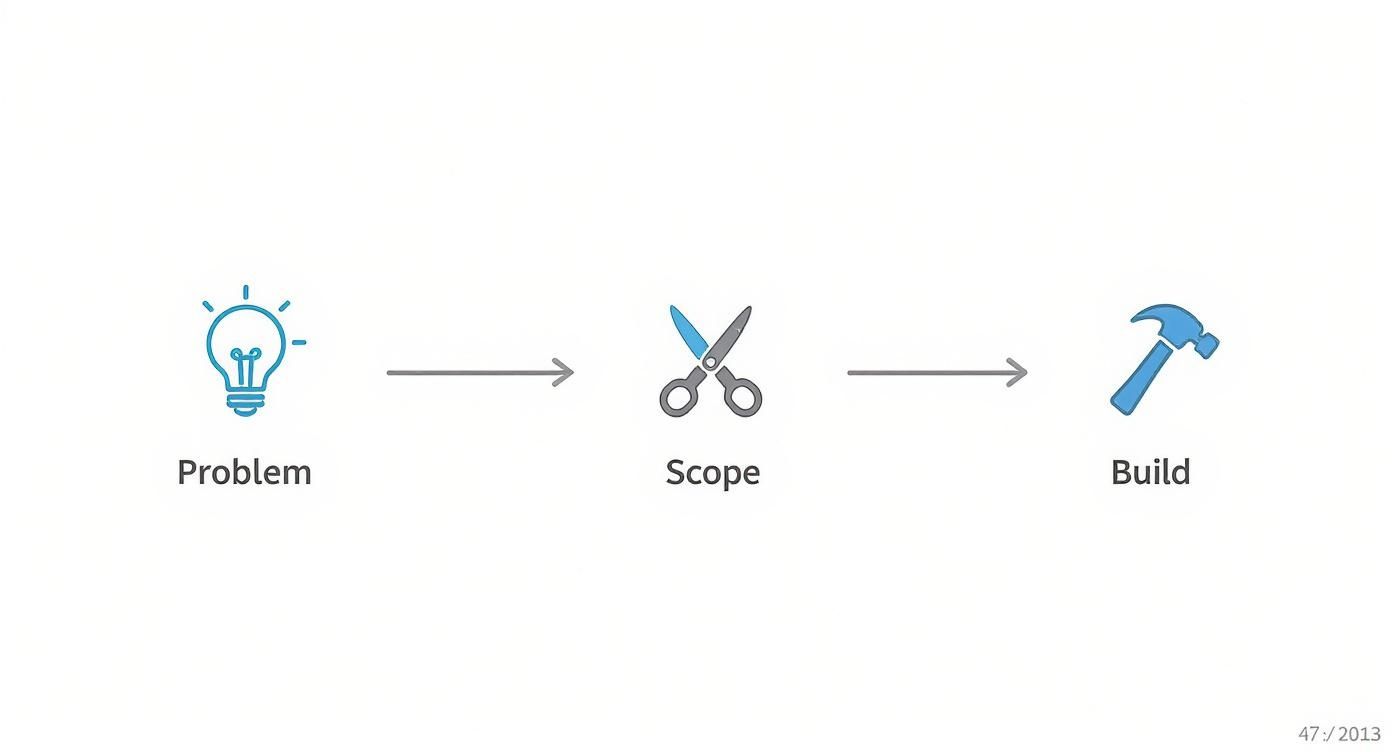
This cycle is all about moving from a core problem to a tightly scoped MVP that you can actually build and get into users' hands. Let's break down how it works in the real world.
The Build Phase: Quality Over Quantity
This is where the rubber meets the road and your prioritized feature list starts to take shape as a real product. The goal here isn't to build everything at once. Far from it.
You should be focused on short development sprints—think one to two weeks—that result in a small, testable, and high-quality piece of your product.
I can't stress this enough: quality is everything at this stage. A single, solid feature that solves the user's core problem is infinitely better than five half-baked features that just lead to frustration. A buggy experience pollutes your feedback; you won't know if users hate the idea or just the poor execution.
The Measure Phase: Defining Success Before You Start
Before a single line of code gets written, you absolutely must know how you're going to measure success. The "Measure" phase is all about gathering the right data—both quantitative and qualitative—to understand what users are really doing with the feature you just shipped.
It's easy to get distracted by vanity metrics like total sign-ups or page views. Don't fall into that trap. Focus on actionable metrics that tell you if you're actually providing value.
- User Engagement: Are people using the feature? How often? What percentage of them are completing the main task it was designed for?
- Feature Adoption: Are users even finding the new feature? Is it intuitive enough for them to start using it on their own?
- User Retention: Are the users who engage with this new feature more likely to stick around and come back?
The trick is to get a balanced view. Hard numbers from tools like Mixpanel or Google Analytics tell you what is happening, but user interviews and feedback surveys tell you why. You need both to get the full story.
To help you get started, here are some key metrics you might track depending on what kind of MVP you're building.
Essential MVP Metrics by Product Type
| Product Type | Primary Metric to Track | Example Question it Answers |
|---|---|---|
| SaaS Platform | Activation Rate (completing key setup steps) | "Are new users getting to the 'aha!' moment quickly?" |
| Mobile App | Daily Active Users (DAU) / Monthly Active Users (MAU) | "How sticky is our app? Are people coming back?" |
| E-commerce Site | Conversion Rate (from visit to purchase) | "Are we effectively turning browsers into buyers?" |
| Content Platform | Time on Page / Pages per Session | "Is our content engaging enough to hold attention?" |
Remember, these are just starting points. The right metrics will always tie directly back to the core assumption you're testing in each cycle.
The Learn Phase: Turning Data Into Decisions
Now for the most important part of the whole process. The "Learn" phase is where you step back, look at all the data and feedback you’ve collected, and make a critical decision: do we persevere or do we pivot?
This is where the magic happens. Did the feature move the needle like you thought it would?
- Persevere: If the data looks promising and the feedback is positive, you persevere. This could mean refining the feature, adding more functionality to it, or simply moving on to the next highest-priority item on your backlog.
- Pivot: If the metrics are flat and users are confused or indifferent, it’s time to pivot. A pivot isn't a failure—it's a smart, strategic change of course based on what you just learned. You might tweak the feature, change the target audience, or decide the idea wasn't as valuable as you thought.
For instance, imagine a SaaS company launches a new dashboard feature, hoping it will boost daily logins. After measuring, they see users click on it but leave almost immediately. Interviews reveal the layout is confusing. That's a powerful lesson. The pivot is clear: redesign the UI based on that direct feedback in the next build cycle. You can find more Minimum Viable Product examples that highlight just how crucial these pivots can be.
This entire process is grounded in the principles of the Lean Startup methodology. It’s not a one-and-done checklist; it's a continuous loop that powers smart, customer-focused product development.
Picking the Right Tools for Your MVP
The right software can either rocket-launch your MVP or bog it down in complexity. The goal isn't to hoard a massive collection of tools; it’s about piecing together a lean, clean system that fuels quick cycles of improvement without creating a bunch of administrative drag.
Your tech stack should be your biggest ally in the Build-Measure-Learn loop. Think about the core jobs you need to get done: tracking what’s happening, getting feedback from real people, and making sense of how they use your product.
For Keeping Track of Everything
This is your team's mission control. It needs to be the one place everyone looks to see what’s on the to-do list, who owns it, and how close it is to being done.
- If you need something simple and visual: Tools like Trello or Asana are fantastic for smaller teams. Their Kanban-style boards give you an at-a-glance view of your workflow. No steep learning curve, just pure focus.
- For more complex projects: If your MVP has some serious technical depth or you're coordinating a larger group, a platform like Jira offers much more power. Just be careful—its features can be overkill for a small team trying to stay nimble.
Getting this right has a huge impact. According to recent industry stats, 77% of high-performing projects use project management software to stay on track. This isn't a coincidence. These tools help you monitor your progress in real time and pivot based on feedback. Since 40% of project teams have 6 to 10 members, the MVP approach is a perfect fit for these focused, collaborative groups. You can dig into more stats over at PM360Consulting.ie.
For User Feedback and Analytics
As soon as your MVP is out there, you need to know what’s happening. This is where you get the "what" and the "why" behind every click and scroll.
Your analytics setup should answer one critical question: "Are people actually getting value from the main thing we just built?" If your tools can't tell you that, they're just noise.
For a full picture, you need to blend two types of data:
- The "What" (Analytics): Google Analytics is a solid, free starting point for web traffic. But for true product insights, tools like Mixpanel or Amplitude are purpose-built. They let you track specific actions and see exactly where people get stuck or drop off.
- The "Why" (Feedback): To get inside your users' heads, nothing beats tools like Hotjar for heatmaps and screen recordings. For even deeper insights, UserTesting gives you actual video feedback from people in your target audience as they use your product.
Remember, these choices don't exist in a vacuum. They have to fit with your overall technical strategy. To make sure your project management and development tools play nicely together, take a look at our guide on how to choose the right technology stack.
Common MVP Pitfalls and How to Sidestep Them
Building an MVP is like navigating a minefield. It’s not just about having a great idea; it’s about knowing where the traps are and having the foresight to avoid them. Get it right, and you launch a product that learns and grows. Get it wrong, and you might never launch at all.
Let's walk through some of the most common blunders I've seen teams make and, more importantly, how you can steer clear of them.

The Dangers of Gold-Plating and Scope Creep
So many teams stumble right out of the gate by trying to make their MVP perfect before anyone ever sees it. This is "gold-plating," and it’s the mortal enemy of the "viable" in MVP. It’s that impulse to add just one more shiny feature that seems essential but only delays the most critical part of the process: learning from real users.
I once saw a team building a simple task-management app get completely bogged down. They were convinced they needed complex calendar integrations and fancy team collaboration tools for launch. The core function—letting a user create and complete a task—got buried under features that bloated the product and pushed back their feedback timeline by months.
Here’s a practical way to fight this: adopt a strict one-in, one-out policy. If a stakeholder absolutely insists on adding a new feature, they have to nominate an existing feature of equal effort to be removed from the scope. It immediately forces a tough conversation about what truly matters.
An MVP is not a cheaper version of your final product; it's a tool for learning. Every feature added that doesn't contribute directly to validating your core hypothesis is waste.
Falling for Vanity Metrics
Another classic mistake is obsessing over numbers that look good on a PowerPoint slide but tell you nothing useful. Total sign-ups or page views can feel great, but they don't reveal if anyone is actually getting value from what you've built.
Imagine you launch a social media scheduling tool and get 1,000 sign-ups in the first week. Looks amazing, right? But then you dig into the analytics and discover that 95% of those users never actually scheduled a single post. The vanity metric hid a huge problem: a massive gap between initial interest and real engagement.
Instead, you need to focus on metrics that drive action. Look at things like:
- Activation Rate: What percentage of new users actually complete the core action? (e.g., scheduling their first post)
- Retention: How many people are still around a week after they signed up?
- Feature Adoption: Are users finding and using that one key feature you built the whole MVP around?
These are the numbers that tell the real story of whether your product is hitting the mark.
The Fear of Pivoting
Finally, one of the toughest hurdles is emotional attachment. It's easy to treat your initial MVP idea as gospel. But what happens when the data and user feedback are screaming that your core assumption was wrong? Clinging to your original vision when the evidence points elsewhere is a surefire way to fail.
A pivot isn't admitting defeat. It’s a smart, strategic change of course based on what you've learned. The most successful companies do it all the time. The whole point of an MVP is to learn, and sometimes that lesson is that you need to change direction. Have the courage to follow the data.
MVP Mistake vs. Strategic Solution
To make this even clearer, here's a quick-reference table that pits common MVP blunders against their smarter, more effective solutions. Think of it as a cheat sheet for keeping your project on track.
| Common Pitfall | Why It's a Problem | How to Fix It |
|---|---|---|
| Gold-Plating | Delays launch, wastes resources on unproven features, and muddies feedback. | Enforce a strict "one-in, one-out" rule. Every new feature request requires removing an existing one of similar effort. |
| Chasing Vanity Metrics | Gives a false sense of success while hiding critical engagement or usability problems. | Focus on actionable metrics like activation, retention, and feature adoption. Measure what users do, not just their presence. |
| Ignoring Negative Feedback | Leads to building a product nobody actually wants because you're stuck on your original idea. | Actively seek out criticism. Treat negative feedback as a gift that points you toward what needs fixing. |
| Fear of Pivoting | Wastes time and money building the wrong product, even when the data says to change course. | Treat your initial hypotheses as assumptions to be tested, not facts. Be ready to change direction based on what you learn. |
Keep this in mind as you move forward. Avoiding these common mistakes isn't about being perfect; it's about being smart, agile, and ready to learn.
Common Questions We Hear About Managing an MVP Project
Even the best-laid plans hit a few bumps. The whole point of an MVP is to move fast and learn, which naturally brings up some tricky questions along the way. Let's tackle some of the most common ones we see teams grapple with.
What Does “Viable” Really Mean in an MVP?
This is a fantastic question because it gets right to the heart of the MVP concept. “Viable” doesn't mean polished, perfect, or packed with features. It simply means the product works well enough to solve the core problem for your first users.
It has to be functional and dependable enough that early adopters can actually use it and give you real feedback. Think of it this way: if your goal is personal transportation, a skateboard is a viable product. It’s not a car, but it absolutely gets you from point A to point B. Your MVP needs to deliver that same fundamental value.
How Do We Handle Feature Requests from Our First Users?
First off, getting feature requests is a great sign! It means people are actually using your product and are invested enough to imagine how it could be better. But be careful—if you build every single suggestion, you'll get bogged down by scope creep in no time.
Here's how we advise handling this incoming goldmine of feedback:
- Acknowledge and appreciate: Always thank the user. Let them know you hear them.
- Log everything: Create a single place in your project management tool to track all suggestions. Don't let them get lost in emails or chat threads.
- Hunt for patterns: One person’s idea is just an idea. Five people asking for the same thing? Now you've got a pattern that points to a real, widespread need.
- Align with your goals: Does a popular request support your core hypothesis and get you closer to your business goals? If so, it's a strong candidate for a future sprint. If not, it stays on the backlog for later consideration.
Your early users are your best source of insight, not your to-do list. Their feedback is there to help you understand their problems on a deeper level.
What’s the Difference Between an MVP and a Prototype?
It's easy to mix these two up, but they serve completely different functions.
A prototype is essentially a mockup. It can be a simple sketch or an interactive but non-functional design. Its job is to help you visualize an idea, test a workflow, or gather opinions on a design concept. You can’t use a prototype to do a real task.
An MVP, on the other hand, is a real, working product. It has code, it connects to a database, and it delivers genuine value to a user. You ship an MVP to test a core business idea with real people in the real world.
Simply put: you show someone a prototype, but they use an MVP.
When Do We Know It’s Time to Move Past the MVP Stage?
There isn’t a single finish line, but you'll see clear signals that you're ready to evolve. You’re likely moving beyond the MVP phase when you start noticing a few key shifts:
- You've found product-market fit. You’re not just getting sign-ups; you have a core group of active, returning users who would be genuinely disappointed if your product disappeared.
- Your core assumptions are no longer guesses—they're validated by hard data and user behavior.
- The internal conversation changes from "Will anyone even use this?" to "How do we improve performance and scale this for more users?"
Once you hit that inflection point, it's time to start confidently investing in those "should-have" and "could-have" features you smartly left on the back burner.
Ready to build a high-performance MVP in under 90 days? The expert teams at 42 Coffee Cups specialize in turning your vision into a scalable, market-ready product with our Next.js and Python/Django development services. Let's build your success story together.